
Data and Analytics Trends 2026: The Intelligence Engine Behind Digital Transformation
Introduction
As enterprises recalibrate for growth in a volatile global environment, data and analytics trends 2026 are redefining how organizations generate value from their digital investments. The focus is no longer on collecting more data, it is on building intelligence layers that convert data into decisive, real-time action.
In 2026, the competitive advantage belongs to enterprises that treat data as a strategic asset, not an operational byproduct. Analytics is moving beyond reporting. It is becoming the core engine powering innovation, resilience, and measurable business outcomes.
Below are the defining shifts shaping the next phase of enterprise evolution.
1. AI-Native Data Architectures Become the Enterprise Standard
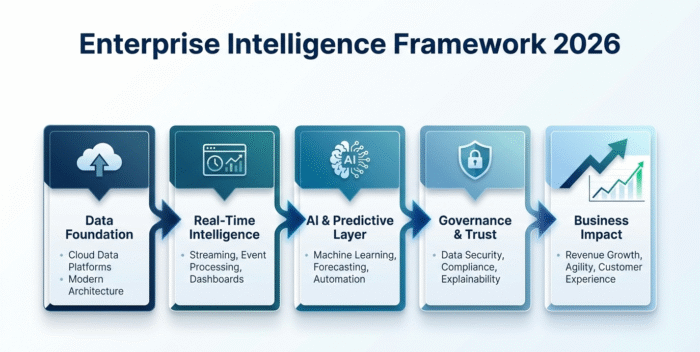
Legacy data warehouses are being replaced by AI-ready ecosystems designed for scale and speed. Organizations are building architectures that support; lakehouse environments, real-time data streaming, vector search capabilities, embedded analytics layers, multi-cloud interoperability
This architectural maturity ensures AI initiatives are not isolated experiments but scalable enterprise capabilities. Modern data foundations are now the backbone of enterprise-wide transformation programs, enabling faster innovation cycles, seamless automation, and consistent insight delivery across business units.
2. Real-Time Decision Intelligence Replaces Static Dashboards
The era of retrospective reporting is fading. One of the most significant data and analytics trends 2026 is the shift toward decision intelligence systems that operate in real time.
Enterprises are integrating event-driven data pipelines, predictive alerting systems, prescriptive AI recommendations, operational automation triggers.
Instead of waiting for quarterly insights, organizations are embedding intelligence directly into workflows from supply chain optimization to customer engagement strategies. This shift transforms analytics from a support function into a strategic decision layer.
3. Distributed Data Ownership Accelerates Innovation
Centralized data models often create bottlenecks. In 2026, enterprises are embracing distributed ownership frameworks, commonly associated with data mesh principles.
This approach enables:
- Domain-driven data products
- Self-service analytics
- Stronger accountability
- Faster experimentation
When business units own and manage their data products, innovation cycles shorten significantly. The organization becomes more adaptive, collaborative, and insight driven.
4. Governance Evolves from Compliance to Strategic Trust
As AI adoption accelerates, governance becomes foundational. Among the defining data and analytics trends 2026 is the evolution of governance frameworks beyond regulatory compliance.
Leading enterprises are prioritizing:
- AI explainability mechanisms
- Automated lineage tracking
- Privacy-by-design architecture
- Ethical AI oversight models
Governance is now directly linked to brand trust, regulatory resilience, and long-term scalability. Organizations that proactively embed governance into their analytics frameworks reduce risk exposure while strengthening stakeholder confidence.
5. Predictive and Prescriptive Analytics Drive Measurable Growth
Predictive analytics is becoming operational rather than experimental.
In 2026, enterprises are deploying models for:
- Customer lifetime value forecasting
- Demand sensing and inventory optimization
- Risk assessment automation
- Behavioral segmentation
- Dynamic pricing engines
Analytics is no longer about hindsight. It is about foresight. Enterprises that embed predictive intelligence into revenue and operational models consistently outperform peers in agility, profitability, and customer experience.
6. Unified Data Ecosystems Enable Enterprise Agility
Fragmented analytics initiatives limit impact. High-performing organizations are integrating cloud data platforms, AI orchestration layers, automation systems, and customer experience engines into unified ecosystems.
This convergence ensures, seamless insight flow across functions, reduced redundancy, scalable AI deployment, faster enterprise-wide transformation
The most successful enterprises in 2026 are not those with the most sophisticated dashboards but those with fully integrated intelligence ecosystems.
The Enterprise Imperative for 2026
The conversation around data has matured. The emphasis is no longer on volume but on velocity, visibility, and verifiable impact.
Data and analytics trends 2026 clearly indicate that sustainable enterprise growth depends on:
- Intelligent data architecture
- Real-time operational visibility
- Responsible AI governance
- Predictive revenue enablement
- Cross-functional data ownership
Organizations that align data strategy with enterprise-wide transformation initiatives will define the next decade of digital leadership.
Frequently Asked Questions
-
Why are data and analytics trends 2026 important for enterprises?
They enable organizations to move from descriptive reporting to predictive and prescriptive intelligence, accelerating growth and resilience. -
How are AI-native architectures changing enterprise analytics?
They allow scalable AI deployment, real-time data processing, and seamless integration across business functions. -
What role does governance play in 2026 analytics strategies?
Governance ensures trust, compliance, and explainability, essential for scaling AI responsibly. -
How does predictive analytics impact revenue growth?
It supports demand forecasting, customer retention strategies, dynamic pricing, and operational efficiency improvements. -
What should enterprises prioritize in 2026?
Modern data platforms, distributed ownership models, real-time decision systems, and integrated AI frameworks.