
Digital Transformation in 2026: Enterprise Trends Shaping the Next Wave of Growth
Introduction: Why 2026 Is a Defining Year for Digital Transformation
As we begin 2026, digital transformation is firmly in a value-extraction phase. Most large enterprises already operate hybrid cloud environments, use analytics platforms, and automate select processes. The differentiator now is how effectively these capabilities translate into speed, resilience, and revenue impact.
Industry research shows that over 70% of digital transformation initiatives fail to meet business expectations, largely due to fragmented execution and lack of intelligence-driven decision-making. As a result, IT services leaders and their competitors are recalibrating toward AI-first, outcome-oriented transformation models.
The trends below reflect where enterprise investments are actually moving in 2026, not theoretical future bets.
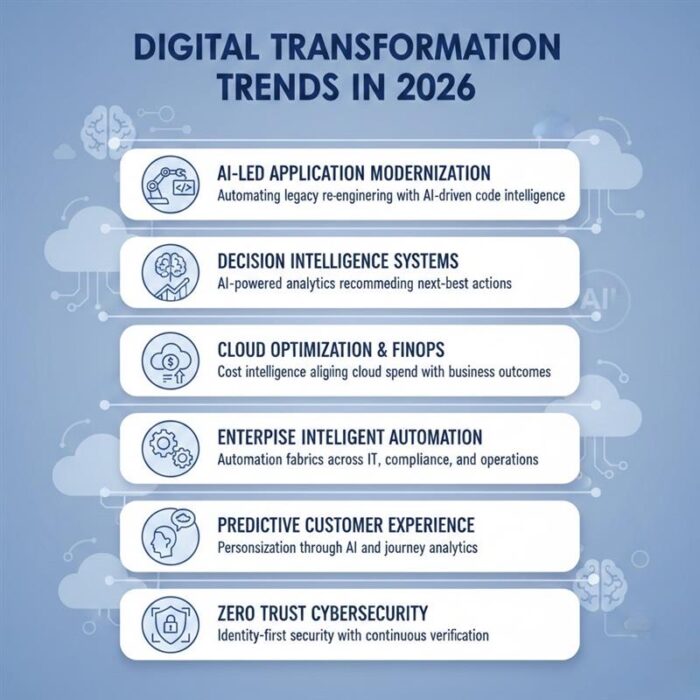
1. AI-Led Application Modernization Replaces Traditional Re-Engineering
Application modernization has been discussed for years but 2026 marks the shift from manual modernization to AI-assisted transformation at scale.
According to industry research, nearly 60% of enterprise applications still run on legacy architectures, creating high maintenance costs and slow innovation cycles. What’s changed in 2026 is the maturity of AI tools that can analyze legacy codebases, map dependencies, and automate refactoring.
What enterprises are doing differently in 2026:
- Using AI to assess modernization feasibility and risk before execution
- Breaking monoliths into microservices using automated code intelligence
- Standardizing modernization through platform engineering
Competitors are investing heavily in AI-powered modernization accelerators, particularly for BFSI and healthcare platforms where downtime is not an option.
Why this trend matters:
AI-led application modernization reduces transformation timelines by 30–40% while significantly lowering operational risk.
2. Analytics Evolves into Decision Intelligence Systems
In earlier phases, analytics answered what happened. In 2026, enterprises expect analytics to recommend what action to take next.
Gartner formally defines Decision Intelligence as the next evolution of analytics combining data, AI, and domain logic to support automated and semi-automated decisions. This shift is visible across industries like banking (risk decisions), retail (pricing), and logistics (route optimization).
What’s driving this shift:
- Explosion of real-time and streaming data
- Need for faster, consistent decisions across distributed teams
- Maturing AI models embedded into business workflows
Competitors are now offering industry-aligned analytics frameworks, rather than generic BI implementations.
Why this trend matters:
Organizations investing in enterprise data and analytics transformation see faster response times and improved decision accuracy across operations.
3. Cloud Strategy Shifts from Adoption to Financial Accountability
By 2026, cloud adoption is no longer the challenge, cloud inefficiency is.
Industry estimates suggest enterprises waste 25–30% of cloud spend due to overprovisioning and poor governance. As a result, cloud strategies are becoming financially disciplined and outcome driven.
Key 2026 cloud priorities:
- Hybrid and multi-cloud architectures aligned to workload needs
- FinOps embedded into cloud governance models
- Cloud-native security integrated early in DevOps pipelines
Competitors are repositioning cloud services around optimization and cost intelligence, not migration alone.
Why this trend matters:
A strong cloud transformation strategy ensures predictable ROI, regulatory compliance, and operational resilience.
4. Intelligent Automation Moves into Core Business Operations
Intelligent automation in 2026 is no longer about isolated bots. Enterprises are deploying automation fabrics that span IT operations, compliance, and customer-facing workflows.
Where automation is expanding in 2026:
- Self-healing IT operations
- AI-driven compliance and audit workflows
- End-to-end process orchestration
Competitors increasingly position intelligent automation for enterprises as a resilience and scalability lever.
5. Customer Experience Becomes Predictive, Not Reactive
Customer expectations continue to rise. Research shows that over 80% of customers expect personalized, consistent experiences across channels, yet most enterprises still operate fragmented CX systems.
In 2026, CX transformation is being driven by:
- Experience analytics integrated with CRM and ERP
- AI-driven personalization models
- Predictive journey orchestration
Competitors are aligning CX initiatives directly with analytics and automation investments.
Why this trend matters:
Data-led CX improves retention, lifetime value, and brand trust.
6. Zero Trust Cybersecurity Becomes Non-Negotiable
With cloud-native architectures and remote work models, perimeter-based security is no longer viable. In 2026, Zero Trust cybersecurity is becoming a baseline expectation.
NIST reports emphasize continuous identity verification, least-privilege access, and real-time threat detection as core principles.
What’s changing in 2026:
- Identity becomes the primary security perimeter
- AI enhances threat detection and response
- Security is embedded across applications, data, and cloud
Competitors are integrating security directly into digital transformation programs.
Final Thought
Digital transformation in 2026 is no longer about keeping pace, it’s about architecting intelligent, secure, and resilient enterprises. Organizations that invest with clarity and discipline today will define the competitive landscape tomorrow.
Frequently Asked Questions
-
Why is 2026 critical for digital transformation?
Because enterprises are shifting from adoption to optimization, intelligence, and measurable ROI. -
Which technologies define enterprise digital transformation in 2026?
AI-led modernization, decision intelligence, cloud optimization, intelligent automation, predictive CX, and zero trust security. -
How does AI change application modernization?
AI reduces risk, accelerates refactoring, and enables scalable modernization without disrupting core systems. -
Why is Zero Trust essential now?
Because distributed systems and cloud-native environments require continuous, identity-first security models.