
Shaping Tomorrow’s iGaming: The Intersection of Next-Gen Tech, Fair Play, and Player Experience
By Konark Khurana, Sr. Director – Gaming & Entertainment, PureSoftware
The iGaming industry has transformed from a niche digital pastime to one of the fastest-growing sectors in global entertainment. What was earlier a fun novelty has now become a powerful force driving cultural and economic change.
According to Future Market Insights, the global online gambling market is valued at USD 105.5 billion in 2025 and is likely to reach USD 286.4 billion by 2035, accelerating at a CAGR of 10.5%. This momentum indicates an industry thriving on constant reinvention driven by progressive regulations, maturing technology ecosystems, and the extensive shift toward mobile-first gaming.
Beyond revenue, iGaming generates substantial GDP contributions through direct spending, taxation, employment, and ecosystem effects. In 2025, the sector was expected to contribute approximately $117.5 billion in global Gross Gaming Revenue (GGR), generating around 350,000 direct jobs in the U.S. alone and billions in tax revenues across regulated markets. If to talk about the global split, iGaming represents approximately 0.1-0.15% of world GDP (comparable to ~$130 trillion global GDP), with indirect multipliers driving impact through tourism, tech innovation, and small business revenues exceeding $52 billion annually in sectors like software and payments.
As the industry expands, expectations rise. With new markets emerging and competition skyrocketing, operators and technology partners face a critical challenge: how can they drive innovation at scale without compromising compliance or player trust?
The Global iGaming Landscape: Markets in Motion
Across geographies, iGaming’s trajectory looks different, but the underlying driver is the same: modernization through digital maturity.
Americas: The United States continues its dynamic state-by-state legalization of online gaming, while Latin American markets like Brazil and Mexico are experiencing unprecedented growth driven by mobile penetration and a young digital population. Brazil, following its recent regulatory breakthroughs, is poised to generate approximately USD 9 billion in revenue by 2027, representing one of the fastest expanding markets regionally. Meanwhile, Mexico and Colombia sustain robust growth. Canada’s evolving provincial frameworks have also accelerated market expansion, with the online gambling segment forecasted to exceed USD 5 billion by 2026, supported by growing digital access and modern payment innovations. Modular platforms auto-localize 97% of content, translating Brazil Portuguese while adapting RTP for Colombian regs.
The U.S. iGaming market is expected to reach USD 26.8 billion in 2025, a 15% increase from USD 23.4 billion in 2024. The Latin America online gambling market is projected to grow at a CAGR of 11.9% from 2025–2030, rising from USD 5.33 billion in 2024 to USD 10.41 billion by 2030.
Europe: This is a mature and highly regulated geography that emphasizes compliance-led innovation and player retention. In 2025, Europe still commands nearly 50% of the global iGaming market share. Europe’s online gambling market was valued at USD 47.21 billion in 2025, with projections reaching USD 64.55 billion by 2030.
APMEA: Markets, including India, the Philippines, and Australia, are driving innovation leveraging AI, payment digitization, and localized engagement models to redefine the player experience. Africa’s online casino gaming reached USD 10.64 billion in 2025 within USD 17.63B total gambling market, driven by mobile penetration across Nigeria, Kenya, South Africa. Mose recently, in November 2025, UAE has launched its first licensed iGaming platform Play 971 offering online casino games, with Wynn Ras Al Khaimah casino opening 2027 to boost USD 752M gaming market.
The Asia-Pacific (APAC) online gambling market size is forecasted at USD 18.53 billion in 2024 and likely to reach USD 20.91 billion by 2025, with a forecast CAGR of ~12.8% for 2025-33. Mobile technology is now the cornerstone of this ecosystem. Around 80% of online casino gaming players primarily play on smartphones, underscoring the need for seamless interfaces, lightning-fast load times, and frictionless gameplay.
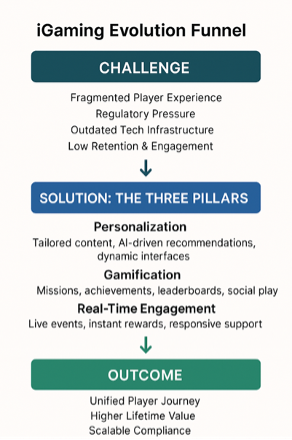
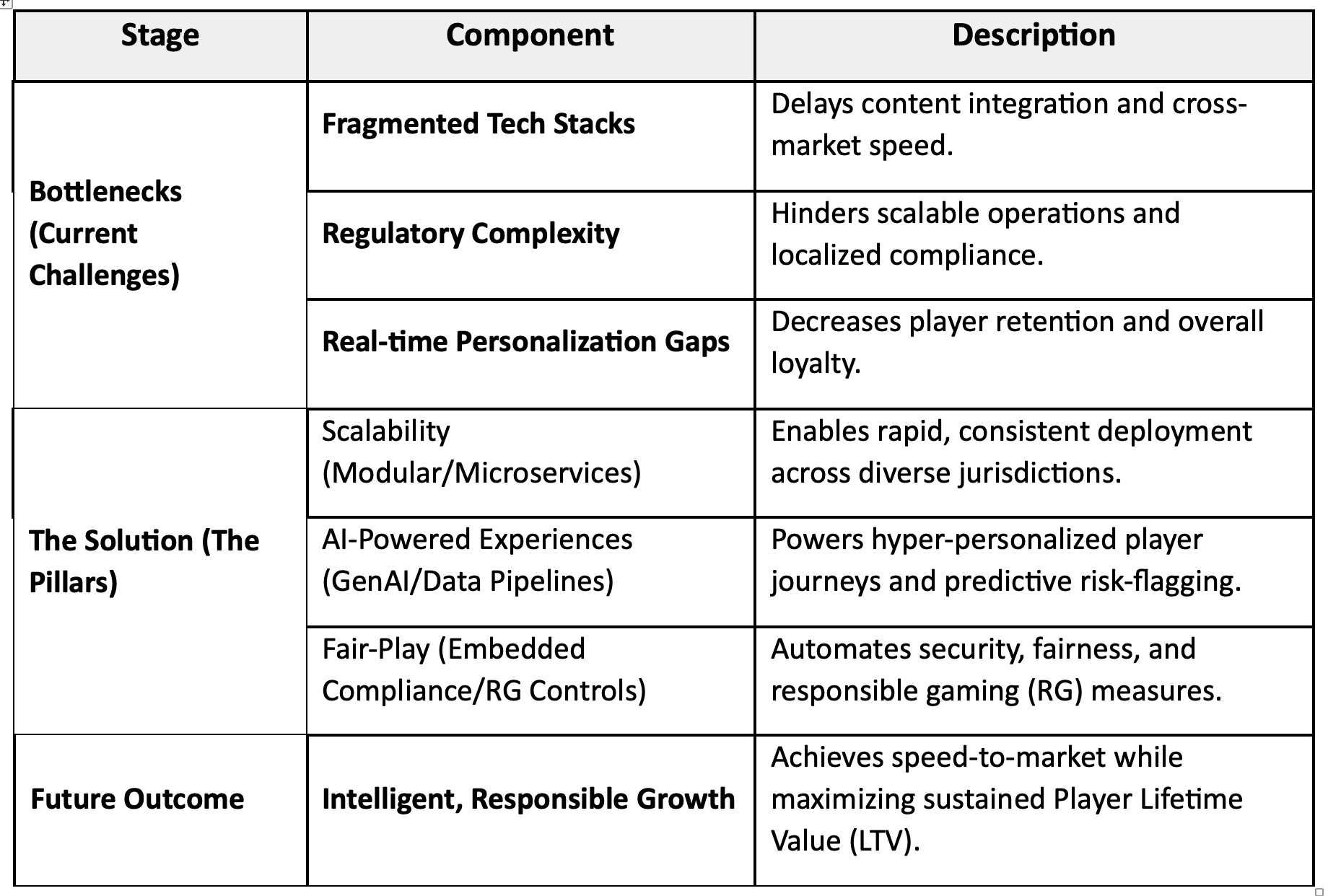
The Bottlenecks: Challenges Slowing Down Growth
Despite the growth trajectory, structural inefficiencies continue to hamper scalability and profitability across the ecosystem:
- Fragmented tech stacks that delay cross-market game integrations and updates.
- Complex regulatory frameworks that vary across jurisdictions, demanding extensive localization and compliance audits.
- Real-time personalization gaps, as legacy data architectures struggle to deliver intelligent recommendations at speed.
- Heightened compliance pressure around fraud prevention, anti-money laundering, and responsible gaming measures.
- GDPR, CCPA, and APAC data laws demand privacy as infrastructure. AI enables consent management at scale, analyzing 1M+ player interactions daily to ensure compliant personalization. Brazil’s new framework mandates data sovereignty: modular platforms auto-configure jurisdiction-specific controls, turning privacy from cost center to competitive edge.
Today’s challenge for operators isn’t whether they can innovate but whether they can do so responsibly, consistently, and at scale.
How Generative AI is Powering the Next Evolution of iGaming?
Generative AI is rapidly becoming the creative and operational backbone of next-generation iGaming, revolutionizing multiple facets of the industry. Beyond streamlining routine tasks, it fundamentally transforms how games are designed, developed, and personalized. From concept to code, AI models accelerate development by generating art assets, characters, storylines, and immersive narratives, drastically reducing time-to-market and boosting creative possibilities.
One of the key operational benefits lies in localization as GenAI enables intelligent, context-aware translation and cultural adaptation of game content, ensuring relevance and resonance across diverse global markets while significantly cutting manual localization effort and cost.
In the critical areas of Anti-Money Laundering (AML) and Know Your Customer (KYC) compliance, GenAI’s advanced data analysis capabilities help identify suspicious activities and automate regulatory reporting with higher accuracy and speed. This enhances security frameworks and supports responsible gaming initiatives, ensuring regulatory adherence while protecting player trust.
Additionally, GenAI amplifies development efficiencies by automating coding, testing, and quality assurance processes, allowing developers to focus on innovative gameplay mechanics and user experience. This orchestration leads to more rapid iterations, reduced operational overhead, and increased scalability.
Together, these applications position GenAI as far more than a creative aid, it is becoming a strategic pillar driving innovation, trust, and operational resilience in the evolving iGaming ecosystem. Operators leveraging GenAI gain competitive advantages through faster content cycles, smarter compliance, and deeply personalized player journeys that dynamically evolve in real time.
What will Define Tomorrow’s iGaming Leaders?
The future leaders of iGaming will be those who balance scalability, AI-Powered Experience and fair play at the core of their operations.
- Scalability: Modular architectures and microservices will replace monolithic builds, enabling faster deployment across regulated markets.
- AI-Powered Experience: Real-time data pipelines will fuel hyper-personalized player journeys, powered by AI, analytics, and GenAI-led insights.
- Fair Play: Embedded compliance frameworks and proactive responsible gaming controls will evolve from checkboxes to design principles.
- Partnership: Collaboration between game studios, regulators, and technology providers will define ecosystem resilience. Future winners will focus on ecosystem orchestration by orchestrating studios + operators + payments + regulators. Single APIs now unify RNG certification, KYC sharing, and real-time fraud intelligence across 50+ jurisdictions.
Beyond scalability, AI-powered experiences, fair-play and partnership lies sustainability, ethical game design to ensure long-term player health. AI-powered tools now detect problem gambling patterns in advance, enabling proactive self-exclusion and spend limits. Regulators increasingly mandate these as KPIs, making responsible gaming a revenue protector, not just compliance. Platforms embedding AI-driven wellness checks see 25% higher LTV through trust-built retention.
A Paradigm Shift: The Convergence of Compliance and Creativity
The shift to Agile and modular architectures isn’t just about faster code deployment, it fundamentally changes the relationship between compliance and creativity. Historically, regulatory adherence was a slow, expensive check-box process bolted onto the end of development, often stifling innovation. Tomorrow’s platform, powered by intelligence (AI), embeds these controls directly. For instance, a single microservice for a game’s Random Number Generator (RNG) can be instantly updated and validated across multiple regulatory schemas, while an AI system proactively flags potential responsible gaming risks in real-time. This integration ensures that the pursuit of trust through both security and player protection, becomes a constant, automated feature, not a periodic friction point, allowing creators to focus purely on exceptional game design and player experience.
The Technology Edge: Building Future-Ready Platforms
Next-generation gaming platforms are solving today’s challenges by fusing automation, compliance, and creativity. Unified frameworks, cloud-native game engines, and AI-assisted design environments are reducing time-to-market while enhancing quality and consistency. Through GenAI-powered ideation and testing, developers are now able to streamline game creation from art and theme conceptualization to logic coding, cutting development cycles significantly while improving player satisfaction. In essence, technology isn’t just supporting the iGaming business. it’s shaping its very DNA.
The Road Ahead: Growth with Integrity
The next decade of iGaming won’t just be about expansion, it will be about intelligent, responsible growth. Operators and suppliers that thrive will be those that embrace open architectures, AI-driven insights, and a player-first mindset.
As regulators, developers, and operators converge, one truth stands out: the iGaming leaders of tomorrow will not only innovate faster, but they’ll also innovate smarter, building ecosystems founded on transparency, agility, and trust.
Sustained leadership will demand platforms that combine speed, compliance, and creativity, empowering studios and operators to deliver exceptional player experiences without compromising regulatory readiness.
The future of iGaming will belong to those who can innovate with intelligence and lead with fair-play, transforming every challenge into an opportunity to reimagine play, performance, and possibility. At PureSoftware, our vision aligns with this evolution. With the Dash iGaming Framework™, we’re helping gaming companies build and launch next-generation experiences across jurisdictions.
Frequently Asked Questions
-
What is driving iGaming’s global growth in 2025?
A mix of regulatory expansion, mobile-first adoption, AI integration, and rising digital payment adoption is fueling industry growth worldwide. -
Which regions are leading the iGaming market?
Europe holds nearly 50% of the market, followed by rapid growth in the U.S., Brazil, Mexico, and mobile-driven APMEA regions like India and the Philippines. -
How is AI transforming the iGaming industry?
AI enables real-time personalization, predictive analytics, faster testing, and enhanced fraud detection, creating more engaging and secure player experiences. -
What challenges do iGaming operators face today?
Fragmented technology ecosystems, multi-jurisdictional compliance, personalization complexity, and responsible gaming regulations are major hurdles. -
What’s the future outlook for iGaming in the next decade?
Expect smarter, modular, and compliance-first platforms driven by AI and automation—ushering in an era of player trust and cross-market scalability.